
You’re new to the organisation. Still learning the culture. Still figuring out people.
One day, you join a Zoom meeting 10 minutes late.
Your earlier meeting ran over. You were hungry, so you grabbed a sandwich before logging in.
As you join, a senior colleague smiles and says: “Welcome, welcome… glad you could join our meeting. We were wondering if you would at all be able to fit us into your schedule.”
You want to explain. But you don’t. You stay quiet.
The meeting ends, but the chatter in your head doesn’t .
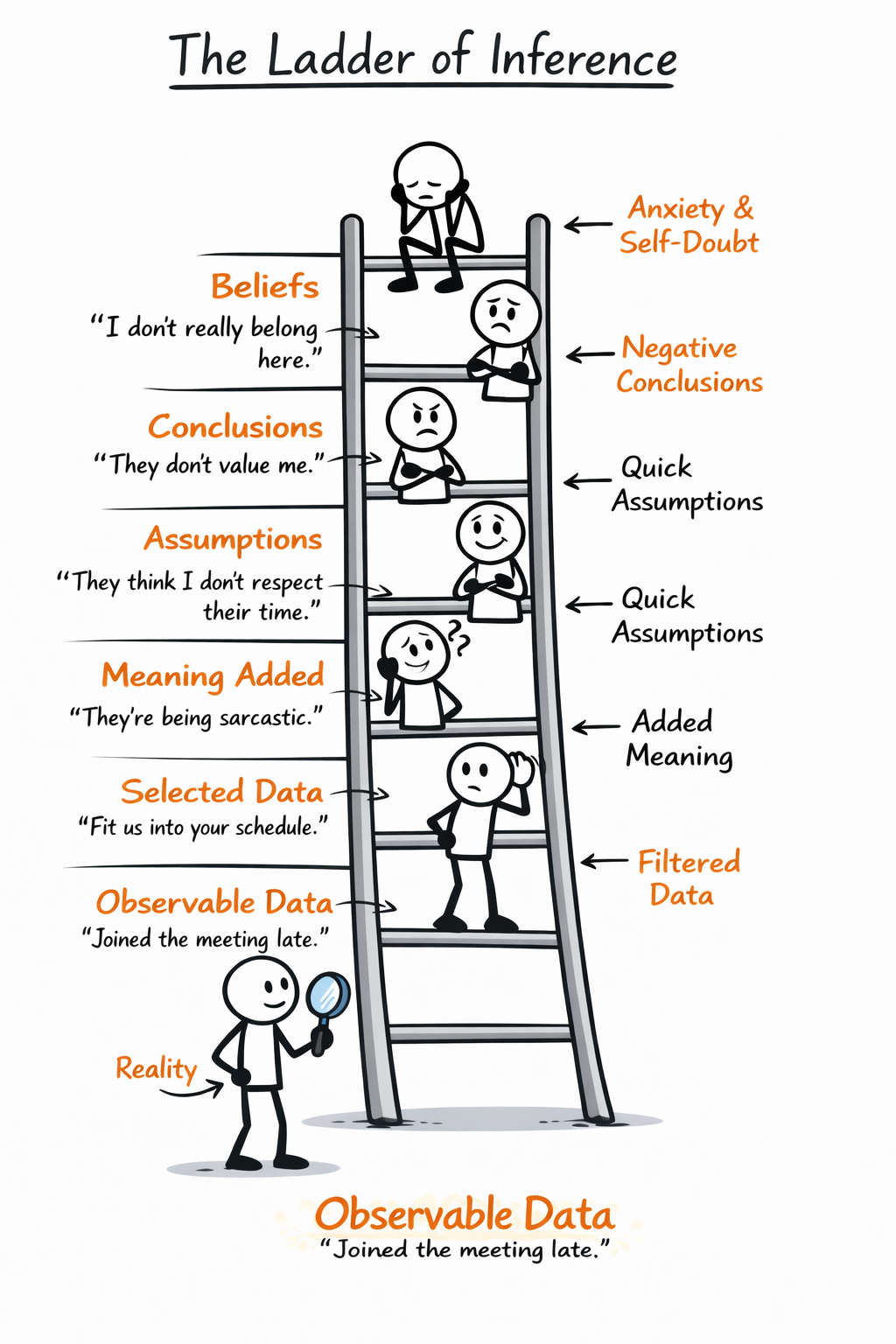
This is a classic downward spiral. And it usually follows a pattern called the Ladder of Inference.
The chatter begins:
– Why did they say that?
– Do I belong here?
– Maybe there are other issues with me.
– Should I start looking out?
What is the Ladder of Inference?
Here’s how it plays out in this situation:
- Observable data
You joined the meeting late. A senior colleague made a remark. - Selected data
You focus on the tone and the words “fit us into your schedule.” - Meaning added
They’re being sarcastic. - Assumptions
They think I don’t respect their time. - Conclusions
They don’t value me. - Beliefs formed
I don’t really belong here. - Actions (or internal reactions)
Anxiety, self-doubt, withdrawal, overthinking, even thoughts of quitting.
All of this—from a single sentence.The goal is not to stop thinking. It’s to slow down the climb.
Here are practical ways to do that.
1. Go back to the bottom of the ladder Ask yourself:
- What exactly did I see or hear?
- What are the facts, without interpretation?
Stick to what’s observable. No adjectives. No mind-reading.
2. Catch yourself adding meaning A simple but powerful question:
- What else could this comment mean?
For example:
- The colleague may have been joking.
- They may not know your earlier meeting ran over.
- They may speak like this with everyone.
Multiple explanations usually exist—we just default to the harshest one for ourselves.
3. Test assumptions instead of carrying them alone. If the thought keeps looping, don’t let it live only in your head.
Options:
- Clarify later: “I joined late because my earlier meeting ran over—just wanted to share context.”
- Sense-check with a trusted peer: “Am I overthinking this?”
Assumptions weaken when exposed to daylight.
4. Watch the story you tell yourself. Downward spirals often shift from:
- “This moment was awkward”
to - “There is something wrong with me.”
That leap is the ladder at work. Notice it. Pause it.
Next time your mind starts racing, ask yourself:
Which rung of the ladder am I standing on right now—and what would help me step back down?
 Perspectives