In an experiment, psychologists gathered 3 real incidents about each participant’s past.
During the experiment, participants were narrated these 3 incidents. And then a 4th one entirely fabricated. For example:
Getting lost in a shopping mall as a child, being reunited by a kind elderly gentleman or a police officer. Or the horrors they experienced being lost.
None of the participants had experienced the incident.
Yet they accepted it; in fact, they recalled the incident in vivid detail.
This is the misinformation effect:
Our brain is not a camera capturing accurate details.
It is a storyteller filing gaps, reconstructing our memory based on suggestions, emotions, time elapsed, conversations after the meeting and most importantly, the story we want to believe.
Why does this matter?
It impacts our relationships at work
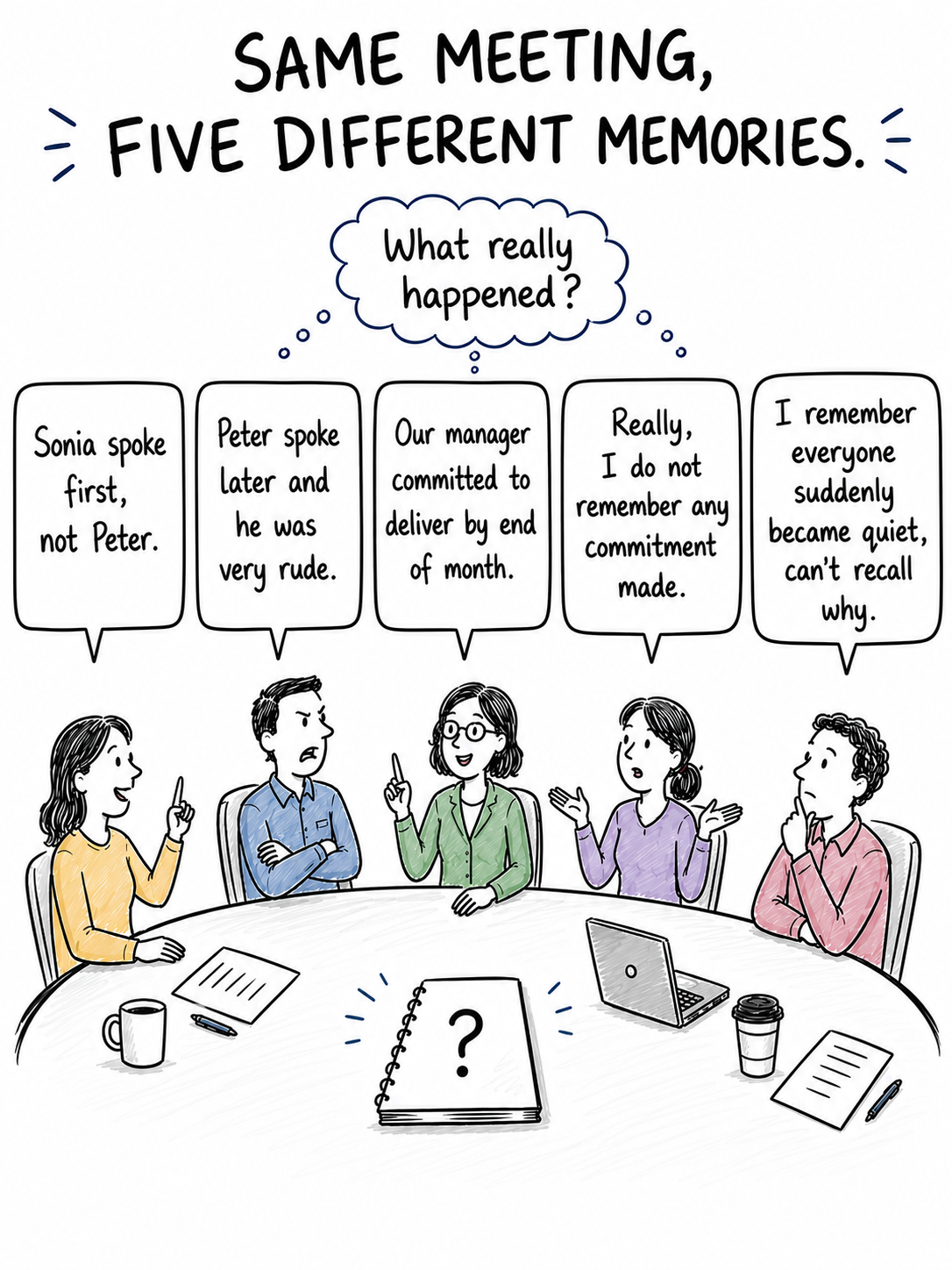
Imagine a heated project review or a miscommunication with a client that happened 6 months back: 5 people from that same meeting, each asked to recall what happened.
You will get five different stories.
One person remembers who spoke first.
Another remembers the tone.
A third is certain a specific commitment was made.
The fourth doesn’t recall any commitment at all.
The fifth remembers the room going quiet — but not why.
All five were present. All five are telling the truth as they remember it.
Learning?
When someone remembers the incident differently, before digging in, I try to ASK:
What if we are both right?
What if we are both wrong?
Have you heard different versions about the same incident? Share your experience in comments.
At the outset, I would like to thank you for stopping by my Blog.
I believe that there is nothing right or wrong in this world. What’s right in this moment and context may be wrong in another moment and context. This belief has inspired me to name my blog ‘Perspectives’.
Perspectives is a platform for me to share my experiences, thoughts and perspectives on various subjects. You may have a different point of view. I look forward to hearing them, these are the triggers for rich and deep conversations.
On personal front, I live in Mumbai, India. I love to read; Somerset Maugham and Nevil Shute are my favorite authors. My favorite books are The Razor’s Edge, Mrs. Craddock, Chequer Board and Gone with the Wind. I am thankful to my father who inculcated the habit of reading in me early on.
I am also passionate about traveling, I have been to most parts of India and to several countries across the globe.
On professional front, I work in Human Resources function. Over two and half decades, I have worked across multiple industries and cultures. I focus on Leadership Development, Talent Management, Visioning and Culture, Large-scale change, Employee Listening & Engagement, Employee Well-being, Inclusive work culture, HR effectiveness, Behavior and Mind-set shifts through sustained interventions
I currently lead Organization Effectiveness Function for Aditya Birla Group, a $44.3 billion conglomerate with 120000 employees across 35 countries.
I sincerely hope that you will enjoy reading my blog. I look forward to your thoughts and suggestions.
Thank you!
View all posts by Padma Rajeswari