
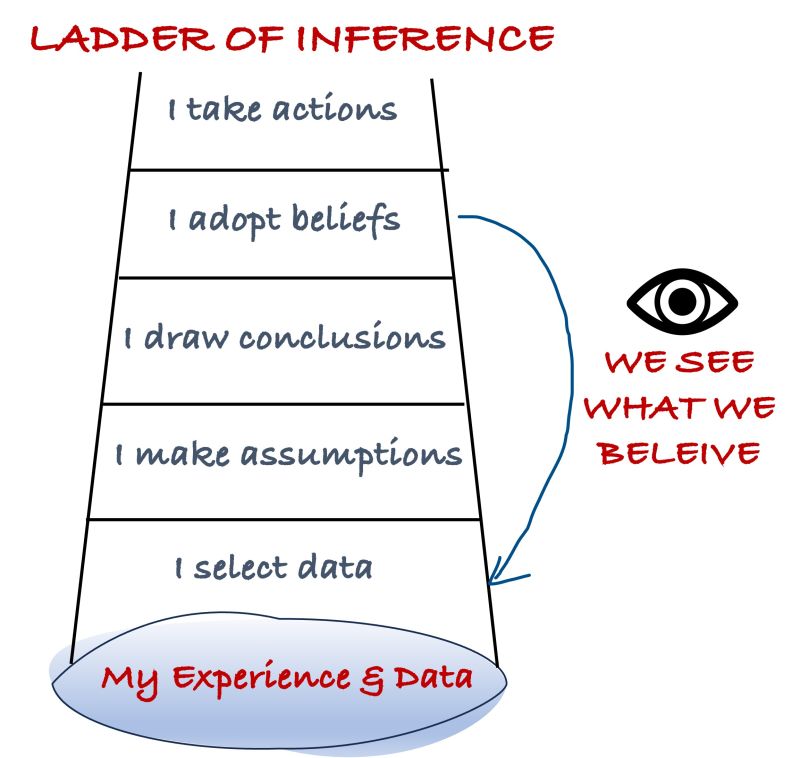
How do our beliefs influence what we see? Ladder of Inference by Chris Argyris brings out this concept exceptionally well.
Let’s take a common example from our lives, especially if we have teenage children at home. Say, you teenage son goes out for a party on Friday night. The curfew time is 10 pm.
The clock turns 11:30 pm… time slips into 12 am… As you pace in the drawing room, you get angry. “He could have at least called to inform he will be late” You call his number, the phone is turned off. Now your anger turns into worry…. “has there been accident?” “what if he is lying somewhere, unattended”.
As you are about to dial his friend’s number, your teenage son walks in. The clock strikes 12:45 am.
Before he could say anything, you let out your emotions and tell him in a terse voice – “You are grounded, no more parties for rest of the month! You first have to prove you are responsible.”
Sounds familiar? What if there was a valid reason behind breaking his curfew time? We would never know.
Chris Argyris proposes the concept of The Ladder of Inference! When faced with situations like this, we tend to quickly climb up the ladder, in a matter of few seconds… that too involuntarily
1. We select few data from the available pool of data
2. Based on that selected data, we make assumptions – “my child is irresponsible, or there has been an accident”
3. We go on to make conclusions and develop beliefs – “children should never be given this sort of freedom, it spoils them!”
4. We act on that belief – “ground the child”
Such situations are equally common in our professional lives – impacting how we interpret the actions, behaviors or decisions of our colleagues, team members or leaders.
More importantly, it tends to get reflexive. Over a period of time – we start seeing what we believe in! If we believe that a team member as dull, missing deadlines… we end up seeing only that in the person. If we believe that a manager is unfair… we will only see that in him / her.
So, the best approach to deal with this is “TO STAY AT THE BOTTOM OF THE LADDER”
Stay with the data… and avoid climbing the steps in the ladder….
 Perspectives